WS&S

Wargames, Soldiers & Strategy

Saturday, March 12, 2016

Small Table 28mm - Battle of Wakefield Road. Turns 10 through 14.

Turn 10

Parliament: The army have 3 moves and so are all now on the table.
Okey's Dragoons fire on Foulston's Dragoons and cause disorder, but one casualty saved.

Royalist: Okey' Dragoons cause a hit and disorder on Foulston's Dragoons.
Remainder of army advance 1 move.


The whole Parliamentary army is now on the field.


Royalist army advance one move.

Turn Eleven


Royalist dragoons fire and miss
Parliamentary dragoons fire one hit which is saved.


Royalist horse battalia move 3 onto the road.


Foot battalia move 2 toward wall. Artillery also make a battalia move of 3.


Parliamentary horse fail roll.
Foot advance 3 to wall.
Artillery move 1.

Turn Twelve

Parliament:

Okey's Dragoons cause a further hit on Foulston's Dragoons.


Foot battalia move 3 to the wall.


Horse battalia advance and go into line.


Artillery advance 1.

Royalist:

Horse to advance and form line (fail)


Horse battalia move 3 and enter grounds of house and so occupy house with the Dragoons,


Artillery battalia advance South 2 moves.


View of the action.


Turn Thirteen

Royalist:

Foulston's Dragoons fire and miss, but in return suffer a further casualty and fail break test.


They are removed from the table.


Foot battalia move 2 and horse battalia fail (again!) artillery battalia advance and unlimber.

Parliament:

Waller's Horse charge Gerard's Horse and cause disorder and two hits in close combat. Supported by Ireton's Horse. They suffered five casualties but saved three of them.


Foot battalia fail.


Artillery move 1.


Royalist artillery deployed but cannot fire into cavalry melee.


Rawdons foot are in the building.


Turn Fourteen

Parliament:

Two foot regiments fire on house causing two hits, one of which is saved
Okey's Dragoons fire on house causing one hit,


Waller's Horse smash into Gerard's Horse scoring eight hits, four of which are saved. However the unit fails its break test.


Gerard's Horse are removed from the table. Parliament artillery advance three moves including unlimbering.


Royalist:

Foot battalia 3 moves so all are now in the house and grounds, I see the building as the main with a number of outbuildings in a walled enclosure, an adhoc fort.


Blewcoates score 3 hits on Oglesby's foot, one save.
Rawdon's foot score 2 hits on the London Trained Band, no saves.


Horse battalia, two moves and charge Waller's Horse. In melee they score 7 hits of which 3 are saves, however, Waller's Horse are broken and leave the field.


Waller's Horse are gone.


So as turn 15 approaches, the Royalists have lost two units to Parlaiments one. The battle is still on a knife edge, the Royalists making a stand in the house and grounds, each sides horse are cancelling each other out whilst the artillery is still trying to get into action.

I shall pause here and continue in daylight tomorrow. Be sure to call back.

Small Table 28mm - Battle of Wakefield Road. Turns 1 through 9.

So with the table set up, the troops chosen and the time to fight it, the battle can take place.

Setting the Scene.

January 1643, Yorkshire.

Royalist forces under Lord Newcastle are capturing town after town in the North of England. Parliamentary forces, commanded by Lord Fairfax are being hard pressed after two defeats in rapid succession. He realises that he had no hope of holding Pontefract and ordered Sir William Brereton, the town's commander, to move his force to join him at Wakefield.

Royalist intelligence discovered the planned move and Newcastle ordered Lord George Goring to take a small force to intercept, hold and if possible defeat Brereton before he could link up with Fairfax.

We join the scene at the junction of the Pontefract and Wakefield Roads.

Turn One

Royalist win initiative and successfully deploy Foulston's Dragoons who enter the field from the North West.
Parliament: fail initiative roll.


No sign of the Parliamentary army.


Turn Two

Parliament: fail activation roll.
Royalist: fail activation roll and halt to assess the area.


Turn Three 

Royalist: Dragoon's advance a leisurely single move of 9 cm.
Parliament: Okey's Dragoons finally appear on the Pontefract Road.


Turn Four

Parliament : dragoons one move forward.
Royalist: dragoons one move forward. Neither side in any hurry.


Turn Five

Royalist: a sudden urgency sees them move forward three moves (27cm)
Parliament : fail activation roll.


Turn Six

Both fail to activate.

Turn Seven

Royalist: Foulston's Dragoons move two forward and reach West wall of the house, also throw a 6 to allow the rest of the army to begin entering the field from the North West.

Parliament: A sudden urgency sees the dragoons move forward three and almost reach the road junction.


The head of the Royalist army of Lord George Goring enter the field.


Okey's Dragoons finally get a decent roll and approach the junction of the Wakefield Road.


Turn Eight

Parliament: another maximum move brings Okey's Dragoons to the South East corner of the house wall, But fail to throw a 5 or 6 to bring the rest of the army to the table.

Royalist: 2 moves allow Foulston's Dragoons to dismount, scale the walls and occupy the house and grounds. (I have substituted 6 dismounted for 3 mounted for effect, also will avoid confusion with a standard foot regiment). The Royalist army also have three moves and so the whole force is now on the table.


Three battalia of Royalists, one each of horse, foot and ordnance.


Turn Nine

Royalist: Dragoons move close to carbine range.
Main force just one move, horse regiments begin to veer South toward the Wakefield Road.

Parliament: Okey's Dragoons dismount and take up position behind the East wall.
Successful roll also means the lead units of the Parliamentary force now enter on the Pontefract Road.


Royalist horse battalia begin to head for the road.


The Parliamentary army starts to appear on the Pontefract Road.
 

A view from the lead elements of the Parliamentary army.


The whole Royalist army in view to the North West.

So that is the opening moves, I think the smaller unit sizes and substituting cm for inches is working just fine so far. Once combat begins it should be interesting.

So that is update one, please call back to the Tabletop Commanders Blog for the next instalment.

Friday, March 11, 2016

Small Table 28mm - Setting Up

Just a short entry to show my first attempt with reduced sized units in 28mm.

I have gone with the English Civil War and will use the Pike and Shotte rules. As the units are much reduced in size and of course, the table is also very small, I shall measure in cm rather than inches for both movement and firing etc.

I have used a standard sized kitchen table, not a large dining table. It is where I paint all my figures and with the pull out end sections measures one inch less then five feet and one inch shy of three feet. I think most people would be able to manage to find an area that size, even if it means placing a piece of board over the top of the existing table.


The table cleared of all my painting gear,


With the end extensions in place, it measures just under 5 x 3 feet.


Transformed with a Cigar Box Battle Mat.


Add some very basic terrain, Felt roads, homemade bushes, trees and a building.


With sunlight streaming in, it looks decent enough.


The peace and tranquility of this house's residents is about to be disturbed!


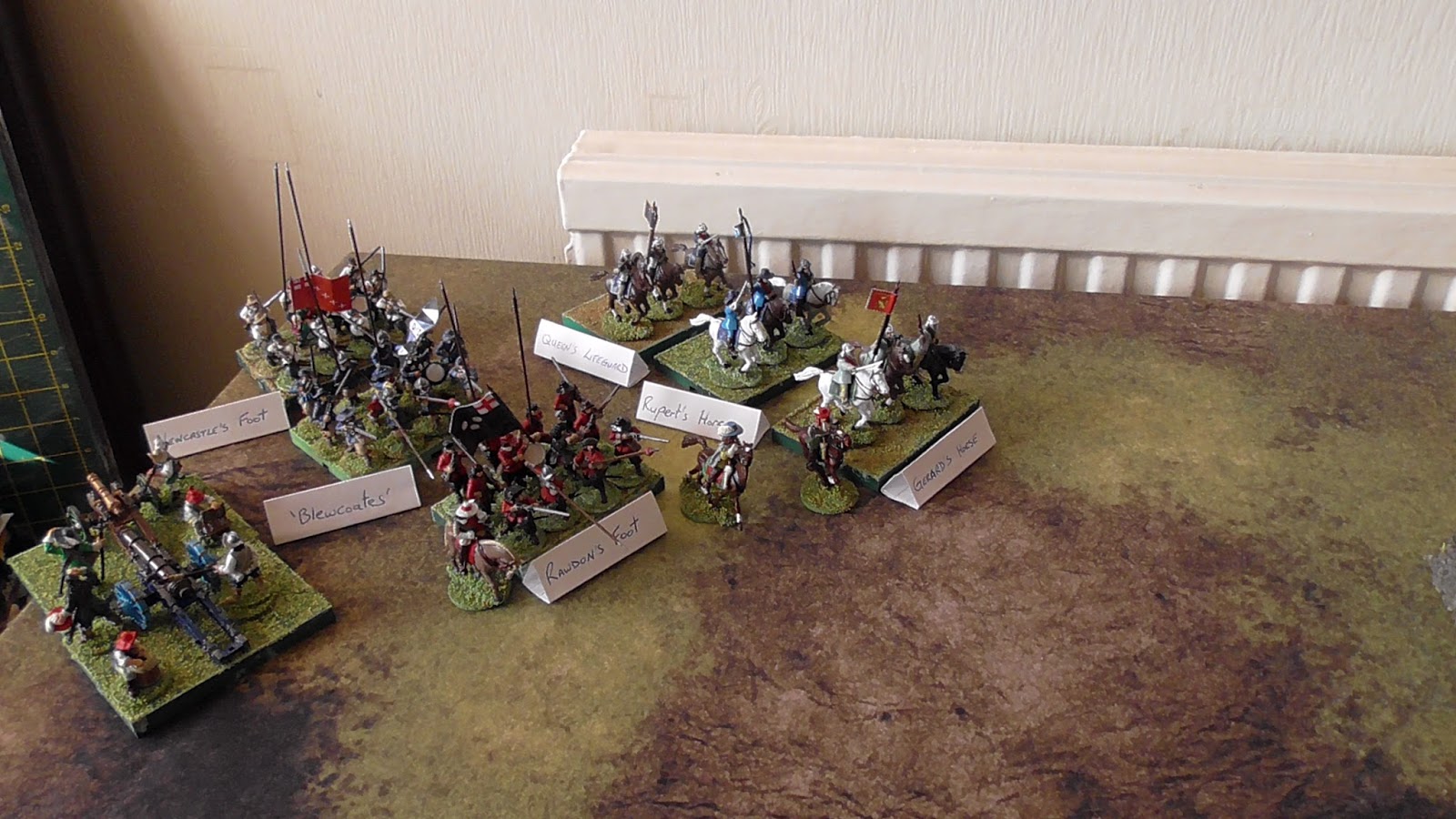
Next select some troops. Here we have the Parliamentary force. I have put labels next to each unit to identify it, not really necessary, but will make a commentary of the battle a little easier. 


The Royalist force is identical with three foot and horse regiments, one light and one medium cannon, plus a leader stand. Even with this few figures I think they look pretty impressive.


Next up is the rule book, I need to do a little bit of re-reading as it is over a year since I played this game.


Finally, dice, markers and all the other paraphernalia that we seem to collect for playing our games.

So now I have to deploy the troops, brush up on the rules and have an enjoyable evening/day, As she who must be obeyed, has given permission for the battlefield to remain in situ for the weekend!

I shall post again with a progress report soon and raise any issues or problems I come across.

Thursday, March 10, 2016

Even more pondering on small tables.

Further to a couple of previous articles regarding using smaller tables to war game. I had been using 6mm American Civil War figures, but what if your armies are 28mm, is it still possible?

I dug out two regiments from my 28mm English Civil War armies, one foot and one horse. I put them on my movement bases which measure four inches by three inches. I normally mount foot regiments for this period on three bases, giving a frontage of twelve inches. Far too big for what I have in mind, so can I cut them down somewhat?

Well of course we compromise all the time in war gaming, my usual foot regiment size in this period is 28 figures, comprising sixteen shot, four command and eight pike. In reality this regiment would number some 500-600 men, so already I have taken a huge liberty in representing the unit.


A full regiment of foot comprising 28 figures on three bases.


They look quite impressive and give a good representation. But even on my 8 x 4 feet table, they take up a lot of space.


I removed one of the bases, and cut down the shot troops by half.


They still look pretty good and now only occupy an eight inch frontage.


Down to one four inch wide base, the shot have been culled to only four figures, pike down to five and command with three. Does it still give the flavour of a regiment of foot?


Obviously much less impressive than three full bases, but I think adequate for a small table, It also only takes up one third of the frontage of the original unit. More importantly, it is still obvious what the unit is.


The same experiment with a regiment of horse. Three models each per base, for a frontage of eight inches and a depth of six.


Once again with a full twelve troopers the unit looks impressive, but is again only a fraction of the hundreds that would have made up the real unit.


Reduce it by fifty percent, a four inch frontage with a six inch depth, very acceptable I think.


The frontage is more important and is now only four inches, the depth less so.


Finally, taking it to its most extreme, a single base with three figures. They also match up quite well to the single base of infantry.


Once again, not so impressive as four full bases, but still obvious what the unit is. The advantages, apart from the much smaller footprint, is of course one box of figures could now represent four regiments of horse. Less cost, painting and faster to get onto the table.

I use Warlord Games 'Pike and Shotte' rules for this period, so will they still work as well with these smaller bases? 

Well ranges of weapons and distances moved need to be altered for a smaller table, maybe use cm instead of inches, or even base widths!

Casualty removal could still be used, though I think the use of some form of casualty marker would possibly work better, given the much smaller units.

Other problems also need solving, how to represent column, hedgehog etc. 
Personally, I enjoy trying to solve questions like this by play testing, something I will be doing on a small table of course.

Naturally, I shall report my findings, along with photographs, to the Tabletop Commanders Blogspot!

Monday, March 7, 2016

Hobby Goals!

Following on from the excellent article by Kurtus on reassessing our hobby, I took some time out to do just that.

Do I use what I have?

Quite frankly, no! I have boxes and boxes of 1/72nd scale figures taking up storage space that are never going to be painted or used by me. Solution - get rid of them. Brutal but true. Some will be given away others possibly sold on that well know auction site.

Am I actually interested or inspired by what I have?

This time I can answer in the positive. I have 6mm American Civil War figures, large armies for both sides. They get used on the table a lot and I also enjoy the period immensely. I have big plans for them.

The recently completed 28mm Wars of the Roses armies, for my campaign game. Again a period that fascinates me and one that I enjoy playing, still a number of rule sets to experiment with too.

Wars of the Three Kingdoms or more commonly known as the English Civil War, again in 28mm, this project has just been resurrected after a year gathering dust. I have about seven more foot units to finish, plus some other odds and ends, such as casualty figures, civilians, dragoon horse holders. To finally complete the project. Once again a period that really interests me and has lots of gaming potential.

28mm Anglo-Saxons and Vikings for Saga. The former are painted, the latter are still in their box along with a scale version of a Viking long ship to create a diorama for use in the Saga games. Another fascinating period with lots of different rule sets available, plus of course other war bands that could be added.

Finally, 28mm Imperial Romans, Gauls and Britons. Only a few test legionaries have been painted up. The remainder sit untouched, definitely a future project that I am looking forward to.

Do I need any more armies?

Of course the standard answer is, 'you can never have too many model soldiers.' The problem is, I am fast running out of storage space for what I already have. Even getting rid of the 1/72 stuff, will only free up limited storage space. The 6mm are not a problem, they sit in a dozen plastic boxes and the whole lot would fit in a large holdall or suitcase. It is the 28mm that cause the problem. They look superb on the table, but each unit requires one or more storage containers, I use plastic tupperware type boxes to hold my figures, and boy, do they mount up. The yet to be painted figures listed above have also to be added to this growing mountain.

Staying focused.

I already have two scales and four periods in my collection. I enjoy all of them too, yes I would love to add a couple of Ancient armies and some American War of Independence armies, oh and I must try my hand at the Marlborough campaigns!!! See how easy it is to continue to grow the mountain.
So the solution is stick with what I have, only add to the existing four eras and forget about new and inviting periods.

The Plan.

I have ordered a couple of buildings and a number of small trees for use with the 6mm ACW. That is really all I need to add at this moment.

Wars of the Roses - I would like to add a couple of light artillery pieces eventually.

War of the Three Kingdoms - I have all I need, buildings, trees etc. are interchangeable with the WotR.

Imperial Rome - Some cavalry for both sides would be nice as well as a chariot or two, buildings for this period are also required.

So you can see, I will still be adding to my storage woes, but at least the few things I plan to purchase are to supplement the armies I already own, without starting off on a new course. The embryonic Roman/Gaul project is going to need the most additions, but even they are small compared to embarking on a new era and armies.

Will it work?

Of course, only time will tell. I am determined at the moment and of course I still have lots of minis to paint still. Maybe a little less painting and little more gaming is the solution, after all, isn't that why we paint them in the first place?